This content is provided for informational or educational purposes only and should not be taken as legal advice. The IAWJ disclaims any warranties or guarantees regarding the accuracy, completeness, currentness, or suitability of the information provided. The opinions, beliefs, and viewpoints expressed in the post are solely those of the guest author and do not necessarily reflect the official policy or position of the IAWJ.
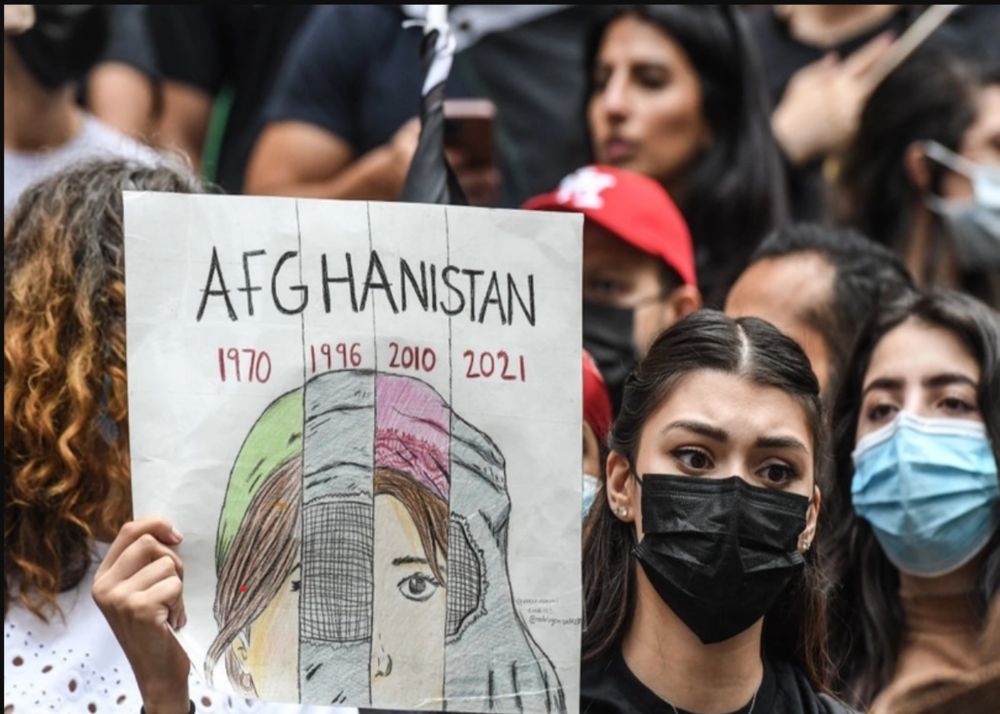
Source: 4 Years of Darkness for Afghan Women Under the Taliban - Observer Diplomat
GENDER APARTHEID IN AFGHANISTAN
Presentation to IAWJ Asia Pacific Regional Conference – Adelaide, Australia 13 May, 2026.
Presenters - former Afghan women Judges Raihana Atahee (now in New Zealand) and Sheela Hassas Zarefi (now in Australia)
INTRODUCTION AND BACKGROUND - Judge Sheela Hassas
The other day, I was trying to find any country or place in the world to compare with Afghanistan, but I couldn’t find one exactly like it. This gave me mixed feelings.
I felt sad because my country, my own land, is one of the worst places for women and girls right now. But at the same time, I felt a kind of strange comfort, thinking that there is no other place quite like Afghanistan. But it was not the same.
Women’s Status in Afghanistan Before the Taliban
1. Before August 2021, Afghanistan, while still facing many challenge, had been making real progress on women’s rights. The Constitution guaranteed equality between women and men and there was strong support, both within the country and internationally, to improve women’s lives.
2. More girls were going to school and university, women were working in different fields, and many were involved in politics and public life. As you all might know, we even had around 270 women judges. The IAWJ was active conducting judicial training for Judges from 2001 right up to 2021 and many Afghan judges travelled to the US on exchange and education programmes co0ordinated by the IAWJ.
3. From 1919 to 1929 Afghanistan introduced major reforms for women – chid marriage was prohibited, women gained the freedom to choose their spouses and education became accessible through the opening of girls’ schools. Notably, women were granted the right to vote in 1919 – earlier than in several Western countries, including the United States.
4. When the Taliban took control of Afghanistan in August 2021 women were immediately targeted and women Judges were all sacked and placed at risk. Women were among the first to respond—taking to the streets in Kabul and other cities in rare public protests. Their demands were simple - the right to study work and moving freely.
5. The Taliban’s response was swift and brutal. Many women activists faced arrests, enforced disappearances, detention, torture, and reports of sexual violence, sending a clear message meant to silence resistance.
6. The Taliban has introduced a sweeping set of rules that systematically strip women and girls of their rights. These policies have pushed women out of public life, limiting their ability to study, work, travel, or even be seen and heard in society. Violence and harsh punishments have become normalized as tools of control. A small number of women are still allowed to work, mainly in the health sector, but even they face strict limitations and discrimination. Overall, the situation reflects a deeply entrenched system of gender-based oppression, where women’s roles, freedoms, and futures are tightly controlled.
7. We hope for greater international support through negotiation and political pressure but not war. We all try to be a voice to the voiceless women and girls of Afghanistan. When we participated in the International Association of Women Judges Biennial Conference in Cape Town last year, we met Judge Halima Saldulker and Judge Margie Victor, who have both played key roles in advancing gender equality in the legal field and share our thoughts and concern about Afghan women and girls.
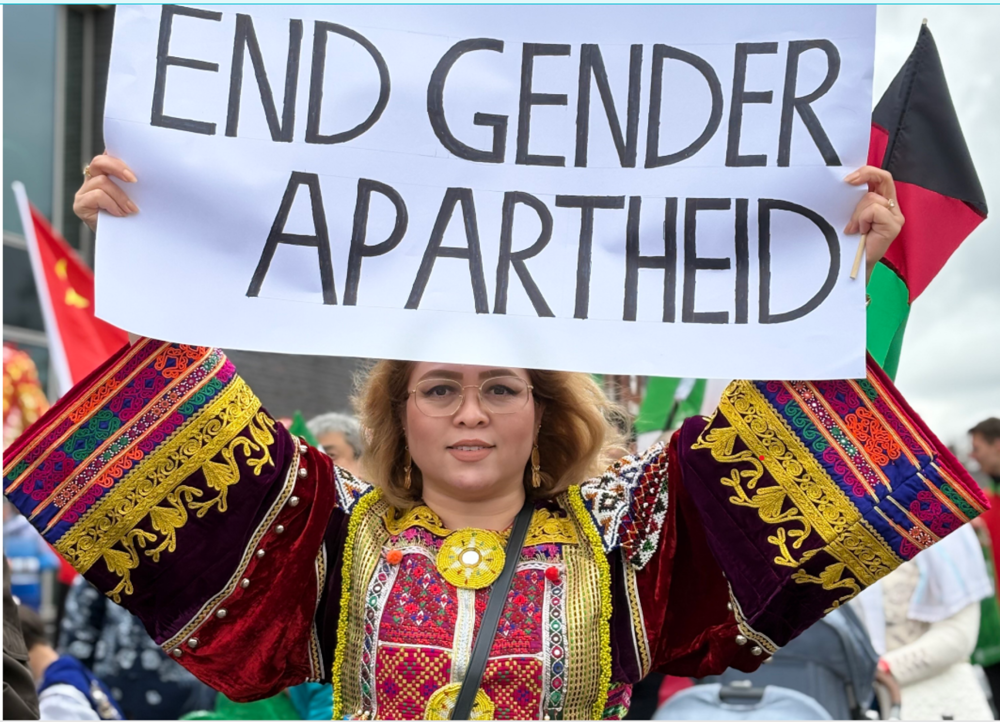
Metra Mehran, an activist from Afghanistan,
Source: Taking Stock of the Proposal to Codify Gender Apartheid in the Crimes against Humanity Convention - Opinio Juris
GENDER APARTHEID IN AFGHANISTAN – Judge Raihana Atahee
Parallels Between Apartheid in South Africa and Afghan Women’s Reality
Between 1948 and the early 1990s, the South African government established and deliberately maintained system of racial apartheid.
State Engineered systems – South Africa enforced racial domination; the Taliban enforces gender-based domination.
Legal and Policing Control – both regimes use laws, decrees and enforcement bodies to restrict the targeted group.
Exclusion from public life — Both systems bar the oppressed group from political, economic, social, and cultural participation.
Rule through fear — Policing bodies act with impunity to maintain domination.
Structured regime of oppression — Both meet the criteria of apartheid as a system of governance.
Preserving dominance — The goal in both contexts is to keep power exclusively in the hands of the dominant group
The term “Gender Apartheid” is not new
The word is strong enough to reflect Afghan women’s suffering and the totality of crimes committed against them.
Women’s rights’ defenders from Afghanistan first popularized the term during the Taliban’s takeover of Afghanistan between 1996 and 2001. Amongst them was Sima Wali in a UN Panel Discussion in August 2022. https://www.un.org/womenwatch/feature/iwd/2002/SW_statement.pdf
In 1999, the U.N. Special Rapporteur indicated in his report to the then-UN Commission on Human Rights that the women of Afghanistan were being subjected to a form of apartheid.
https://opiniojuris.org/2025/04/07/the-growing-imperative-to-recognize-and-codify-gender-apartheid-demonstrating-the-need-and-responding-to-critics-part-i/
End Gender Apartheid “Campaign”
Why Gender Apartheid?
A Victim and Survivor-centric Perspective
At the forefront of the campaign to recognise and codify gender apartheid are the voices are women, girls and LGBTQI+ individuals from Afghanistan.
Apartheid, as distinct from all other international crimes, including persecution
Persecution = acts (denial of rights)— Rome Statute Art. 7(1)(h)
*Intentional, severe deprivation of fundamental rights.
*Focuses on acts committed against a group.
*Can occur anywhere, even without a state wide system.
Apartheid = a regime (a whole political and legal system) — Rome Statute Art. 7(2)(h)
*A system of governance built on segregation and domination.
*Requires institutionalised separation of groups.
*Enforced by laws, policies and state structures.
*Intention to maintain permanent control by the dominant group.
https://endgenderapartheid.today/download/2026/Legal%20Explainer%20-%20Elements%20of%20the%20Crime%20of%20Gender%20Apartheid.pdf
Who Suffers Most Under Apartheid Systems?
Under South African apartheid
Black Women faced dual oppression (race + gender), higher poverty, forced removals, police violence, and denial of education.
Under the Taliban
Women belonging to minorities such as Hazara women face intensified discrimination, violence and exclusion (gender + ethnicity + religion/identity).
Rural women have limited or no media coverage, limited resources and poverty.
LGBTQI+ people face extreme danger including arrests, torture and threats of execution.
Consistent pattern — apartheid systems always hit the most vulnerable the hardest.
The Intergenerational Impact of Gender Apartheid in Afghanistan
Normalising domination — within 10 years from now, children born in 2021 will be 15 having never seen women study, work, or participate in society.
Collapse of women’s services — No women graduating as doctors, nurses, teachers or lawyers since 2021- women’s healthcare and education face imminent breakdown.
Generational illiteracy — Girls grow up illiterate, taught only obedience, with no knowledge of their rights or how to claim them.
Deepening poverty — Women’s exclusion from work destroys economic independence and traps families in long term poverty.
Trauma across communities — Systematic oppression shapes beliefs, behaviours and opportunities for decades.
Women left with no resources to defend their rights.
Boys indoctrinated — Boys are raised on a state controlled curriculum promoting rigid gender hierarchy and hostility to women’s equality.
What the “End Gender Apartheid Campaign” Calls For
“ One cannot prevent and punish what one does not recognise”
Racial Apartheid is a crime under international law (Rome Statute) but not Gender Apartheid.
*UN Negotiates Draft Crimes Against Humanity Convention (CAHC)— first global treaty on crimes against humanity.
*Draft treaty recognises racial apartheid but excludes gender apartheid, leaving a major legal gap.
*Campaign urges states to codify Gender Apartheid as a crime against humanity.
*A historic chance to ensure Afghan women’s experiences are recognised in international law.
*Naming the crime is essential for accountability and deterrence and establishing a precedent.
Proposed Definition for Gender Apartheid (GA)
The following amendment is proposed to the definition of the “crime of apartheid” contained in Article 2(2)(h) of the Draft CAHC.
“the crime of apartheid” means inhumane acts of a character similar to those referred to in paragraph 1, committed in the context of an institutionalised regime of systematic oppression and domination by one racial group over any other racial group or groups, or by one gender group over another gender group or groups, and committed with the intention of maintaining that regime.
Elements of the Crime of Gender Apartheid
1. Perpetrator committed an inhumane act against one or more persons referred to in article 2(1) of the Draft Articles, or of a character similar to any of those acts.
2. Conduct committed in the context of an institutionalised regime of systematic oppression and domination by one gender group over any other gender group or groups.
3. The intention is to maintain that regime.
Application to Afghanistan
1. Act of Widespread abuses — Taliban responsible for murder, arbitrary detention, disappearances, sexual violence, and persecution of women, girls, and LGBTQI+ people.
2. Institutionalised subjugation — Systematic policies designed to entrench male domination and exclude women from public life.
*All male government
*Dismantling legal protections — Constitution suspended; oversight bodies dissolved; women’s courts closed; women barred from serving as judges and many professions.
*Legislated exclusion — Laws prevent women’s participation in public life and restrict their personal development.
*“Virtue and Vice” Law — Enforces strict dress codes and bans women’s voices in public spaces.
*2026 Criminal Procedure Code — Gives men legal authority over women, including permitting physical punishment.
3. Evidence of Intent
*Intent shown through actions and statements — Can be inferred from deeds, public utterances, policies, and the systematic nature of abuses.
*Progressive oppression — Taliban actions consistently aim to dominate women, girls, and LGBTQI+ people and reinforce their regime.
*Gender discriminatory decrees — Leaders justify bans and restrictions by asserting male superiority and women’s subordinate status.
*Over 150 discriminatory laws — Systematic targeting through laws, regulations, and policies designed to exclude and control women and LGBTQI+ individuals.
*Male dominant power structure — The objective is to keep all political, legal, and social power in the hands of men.
*Ideology of female inferiority — Taliban doctrine treats women as of lesser value and men as inherently superior.
Supporting Codification of Gender Apartheid (as of March 2026)
Since the launch of the Campaign, support for the concept of gender has rapidly grown, including at the state level.
Countries explicitly supporting codification of Gender Apartheid in the Crimes Against Humanity Convention include:
Afghanistan (recognised government, not Taliban), Australia, Austria, Brazil, Chile, European Parliament, Iceland, Luxembourg, Malta, Mexico, Portugal, The Philippines and Spain
Countries recognising Gender Apartheid in Afghanistan include:
Albania, Canada, Costa Rica, Ecuador, Italy, Montenegro, Namibia, the Netherlands and Peru
Albania has stated, “We need to call them by their name: yes, it is gender apartheid. The word is strong, but it is the right word. It reflects the horrible reality.”
The European Parliament has called “for the EU to support the recognition of gender apartheid as a crime against humanity.”
Internationally, support for codification of gender apartheid is gaining momentum, including the U.N. High Commissioner for Human Rights, the U.N. Working Group on the Discrimination against Women and Girls, the UN Special Rapporteur on the Situation of Human Rights in Afghanistan and Amnesty International.
The UN Secretariat stated: “In Afghanistan, unprecedented, systemic attacks on women’s and girls’ rights and the flouting of international obligations are creating gender-based apartheid. This deliberately undermines the development of a country that desperately needs the contributions of all, in order to return to sustainable peace”.
Implications of Recognition and Codification of GA
Codification would not solve everything, but it would create legal, political, social and moral implications:
Legal Implications
International Accountability — Enables bodies like the ICC to prosecute.
Expansion of Human Rights Law — Elevates gender based segregation to the same legal seriousness as racial apartheid.
Precedent for Future Cases — Creates a legal foundation for addressing similar abuses globally.
Political & Diplomatic Implications
Pressure on the Taliban — Recognition increases diplomatic isolation and raises the cost of continued violations.
Global Solidarity — Unifies governments and NGOs under a shared legal framework.
Policy Reorientation — Influences how states approach aid, sanctions, and engagement with oppressive regimes.
Social & Humanitarian Implications
Validates Afghan women’s lived experiences and strengthens their demands for justice.
Humanitarian Access — Frames gender oppression as a humanitarian emergency, prompting stronger global responses.
Awareness — Introduces “gender apartheid” into global discourse, shaping public understanding.
Long Term Implications
Legal Reform — Could inspire legislative changes worldwide.
Cultural Transformation — Helps shift global norms toward gender equality as a universal right.
EGA Legal Brief.pdf
Other Legal Steps Taken to Hold the Taliban Accountable
International Court of Justice (ICJ)
In September 2024, Australia, Canada, Germany and the Netherlands initiated action under CEDAW, calling on Afghanistan to cease violations against women and girls.
Supported by 22 additional states, this would be the first ICJ case prosecuting a regime of violation of women rights.
The case is still in the pre filing stage, as the Taliban has been given time to rectify the violations.
International Criminal Court (ICC)
Numerous complaints have been filed alleging Taliban human rights violations since 2021.
People’s Tribunal on the Women of Afghanistan (2025)
Found that Taliban policies amount to gender persecution and “Other Inhumane Acts” under the Rome Statute.
Determined the situation meets elements of an apartheid like system, but cannot be prosecuted as gender apartheid because it is not yet codified in international law.
Request of the IAWJ and Members
Support recognition that what is happening in Afghanistan is not merely discrimination, nor isolated abuses, but a system of governance that meets the threshold of gender apartheid.
Support codification: the Crimes Against Humanity Convention explicitly includes gender apartheid as a crime, closing the impunity gap that has allowed such regimes to operate without accountability.
Support inclusion: that Afghan women, survivors, and affected communities be meaningfully included in the treaty process to shape an effective legal framework.
Call for action: that states use every available mechanism, legal, diplomatic, and political, to prevent, punish, and dismantle gender apartheid in Afghanistan and wherever it occurs.
Use the Term GA actively and urge your states to join countries supporting codification and recognition.
Authored by former Afghan Judges Raihana Atahee and Sheela Hassas Zarefi